Iqbal’s philosophy a guidance for youth in present era: seminar
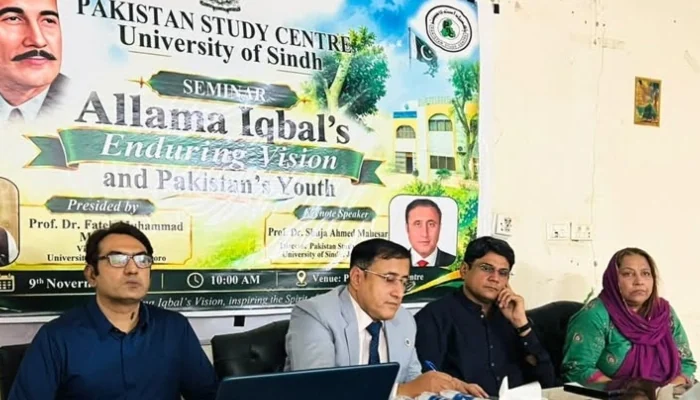
SUKKUR: Allama Iqbal’s philosophy of self-realisation, intellectual awakening, national consciousness and collective responsibility continues to provide effective guidance to young people in addressing the social, economic and political challenges of the present era.
Speakers expressed these views while addressing a national seminar titled “Allama Iqbal’s Enduring Vision and Pakistan’s Youth” organised by the Pakistan Study Centre, University of Sindh, Jamshoro, to commemorate the birth anniversary of the great thinker and Poet of the East, Allama Muhammad Iqbal. The seminar aimed to highlight Allama Iqbal’s intellectual, philosophical and political contributions, as well as the contemporary relevance of his thoughts for Pakistan’s younger generation.
In his presidential message sent to the seminar, Vice Chancellor Prof Dr Fateh Muhammad Marri (TI) paid rich tribute to Allama Iqbal for his invaluable contributions to literature, philosophy and the intellectual awakening of the Muslim Ummah.
He said that Iqbal’s revolutionary poetry carried a timeless message of self-respect, courage, determination, self-confidence and self-realisation. He added that through his poetry, Allama Iqbal had particularly encouraged the younger generation to recognise their abilities, develop self-confidence and strive continuously to achieve higher goals in life.
He appreciated the Pakistan Study Centre for organising the academic event, saying that commemorating Iqbal Day through meaningful academic and intellectual activities was the need of the hour.
He said that universities had a fundamental responsibility to promote constructive thinking, research, creativity and leadership qualities among students. Dr Marri emphasised that universities should prepare responsible, talented and enlightened citizens capable of effectively addressing contemporary national and global challenges. He urged the younger generation to seek guidance from Iqbal’s philosophy and carry forward his ideals for the betterment of society and the country.
Speaking on the occasion, Director Pakistan Study Centre Prof Dr Shuja Ahmed Mahesar described Allama Iqbal as an eminent national poet and philosopher, adding that his intellectual message had played a revolutionary role in shaping political consciousness among the Muslims of the subcontinent. He said Iqbal’s poetry and philosophical writings had awakened Muslims from political and intellectual stagnation and instilled in them a renewed sense of identity, self-confidence and self-respect. He added that Iqbal’s concept of Muslim nationhood was based on shared religious, historical, cultural and civilisational values.
Highlighting the evolution of Two-Nation Theory, Dr Mahesar described Iqbal’s historic Allahabad Address of 1930 as particularly significant, which provided an important intellectual and political direction to the Pakistan Movement.
He said that Allama Iqbal had proposed the unification of Muslim-majority provinces into a new Muslim state to ensure the protection of the linguistic, ethnic, cultural and religious values of Muslims. He added that Iqbal’s poetic and philosophical ideas had generated self-confidence and renewed hope among Muslims, thereby further strengthening the freedom movement.
Dr. Mahesar further said that the youth of Pakistan were the country’s greatest national asset. He noted that more than 60 per cent of Pakistan’s population consisted of people below the age of 30. He observed that if young people were equipped with quality education, technical skills, self-confidence, discipline and leadership abilities, they could transform Pakistan into a strong, economically prosperous country with a prominent position at the global level.
Chairman Department of Anthropology and Archaeology Dr Abdul Razaque Channa highlighted the contemporary relevance of Allama Iqbal’s philosophy of “Khudi”.
He urged young people to realise their individual abilities, develop self-confidence, maintain intellectual independence and establish clear goals in life. He said Iqbal’s message of self-realisation held particular significance amid changing global social and economic circumstances. Dr. Channa also held an insightful interactive discussion with students on Allama Iqbal’s philosophy, particularly the concepts of “Khudi” and “Shaheen”. On the occasion, students Abeer, Halar, Inam Rind, Bakir Laghari, Aisha Jokhio and Fiza delivered speeches and recited Allama Iqbal’s poetry.