Nukes in Israel, but inspectors in Iran: Pezeshkian
NEW YORK/TEHRAN: Iran’s President Masoud Pezeshkian told the 81st UN General Assembly on Wednesday that war had been “imposed” on the Islamic republic, declaring that Tehran would never stop defending itself, nor would it shy away from negotiations to achieve peace, and noting that while the atomic bomb is in Israel, the inspectors are in Iran.
“War was imposed on us, but we proved that we do not fear war to defend ourselves, nor do we shy away from negotiation for peace, and we stand ready to give our lives to defend beloved Iran,” he declared during his address.
Pezeshkian stressed, “Yesterday, the US president said that Iran is a terrorist. We are victims of terrorism. I come from a country where the leader was assassinated without any legal justification. I come from a country where a school was bombed.
“Look at the children of Minab, children who were bombed and killed. Israel and the United States used their weapons to kill our children; our children had committed no wrongdoing.”
He added, “Lamerd is a small city in Iran. Our children were playing sports in a gymnasium when the United States bombed the facility with cluster bombs that broke into thousands of fragments. They killed our scientists, people, women and children. Terrorists and those who train terrorists label us as terrorists. We only defended ourselves; we are not terrorists.”
The Iranian president said that the United States and Israel attacked Iran with the latest military equipment, but the Iranian people strongly defended their country. “They attacked us, but we did not bow to them. We responded to their attacks, but we did not target civilians,” he added.
“They attacked our schools, hospitals, scientific centres, bridges and infrastructure, which was in violation of international law.”
The president added, “The theme of this session is ‘Rebuilding Trust’. Trust is not built by words. It requires us to avoid double standards. In this region, it is the Israeli regime that possesses the atomic bomb and other weapons of mass destruction. Yet it is Iran that is asked to submit to inspections!”
“Israel massacred 70,000 people in Gaza, yet it was Iran that was bombed while at the negotiating table! Israel has the atomic bomb. It is not a party to the NPT. Throughout its shameful existence, it has not allowed a single inspector into the occupied territories. Yet it is rewarded with billions of dollars’ worth of free weapons, and enjoys impunity to bomb whichever capital it chooses!” he added.
Pezeshkian underlined, “I repeat, the atomic bomb is in Israel, but the inspectors are in Iran! Israel kills, yet Iran is sanctioned! That is the tragedy.
“If we seek justice, friend and rival must be judged by the same standard. And human rights must not become an instrument of geopolitical rivalry. Iran seeks no special privilege. It seeks equal rights and accepts the responsibilities that come with them,” he noted.
“Iran’s long history has taught it one clear truth: The world is dangerous for those who lack power. But a world that understands only the language of power is more dangerous still. If trust between nations is lost, even the strongest armies will be unable to create lasting security.”
“Iran extends a hand of cooperation to the world. Our appeal to the world is for peace and justice, not for another war; not out of weakness, but out of confidence in our own strength, and an understanding of this truth: No one in this region will be secure alone. Either we will build security together, or we will endure insecurity together,” he added.
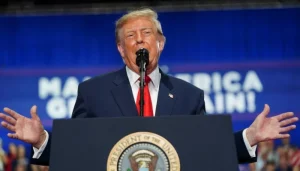
Returning to threats issued by Trump against the Iranian nation, Pezeshkian said, “The remarks made by the US president yesterday [Tuesday] before the global public, thinkers, politicians and legal experts were a clear manifestation of bullying, the logic of force, and a blatant violation of the UN Charter. He should know that threats will make our nation more united and stronger and further strengthen the resistance of Iranians. He should understand that the Iranian nation will not bow to force and will make aggressors regret their actions.”
The president said, “We are ready for dialogue, but let them know that we will not accept the language of force.”
Meanwhile, US President Donald Trump said there is “a lot of momentum” for a deal with Iran. During a meeting on the sidelines of the 81st UN General Assembly in New York that was attended by the Saudi foreign minister, Qatar’s emir, Jordan’s king, the Turkish and Syrian presidents, Egyptian officials, the foreign minister of the UAE and the US secretaries of state and the treasury, Trump said his envoys Steve Witkoff and Jared Kushner had held talks earlier in the day with Iranian intermediaries. “The Iranians respect them both very much, and I think that’s important,” he added. “I think there’s a lot of momentum for them to make a deal. That’s what we’re hearing from everybody.”
Iran’s economy is “in really bad shape,” Trump said. “I hope they’re going to do something that’s really good for their people, and I think they are actually. The other alternative isn’t an acceptable alternative for anybody.” Trump described the leaders at the meeting as “some of America’s greatest and closest friends, allies and partners” working toward “a safer and more prosperous Middle East.”
He said the same group had gathered on the UNGA sidelines a year earlier to discuss ending the war in Gaza, at a time when the conflict “was raging with no end in sight.”
Weeks later, he said, the same countries helped broker “a historic peace deal,” crediting the group with “saving hundreds of thousands of lives” and the creation of the Board of Peace. “Nobody thought it was possible,” he said. “The people around this table made that possible.”
Trump called Iran’s nuclear programme the other long-standing challenge that his administration had sought to address this year.
He credited Operation Epic Fury with crippling Iran’s navy, eliminating its air force, hitting more than 90 percent of its weapons factories, and destroying 450 ballistic missile storage facilities and 800 drone storage facilities.
He said the campaign had also taken out Iran’s air defence systems “almost completely,” and had “decimated its terrorist leadership and destroyed its economy,” with inflation now exceeding 300 percent.
Trump credited Treasury Secretary Scott Bessent with leading Operation Economic Outcast. “We’re completely isolating Iran financially, and we’re just putting the pressure on because hopefully they’ll do the right thing fast before it’s too late,” Trump said.
“There’s going to be a time when it’s too late, and we won’t have a chance of letting them survive as a nation.”
He said the US Navy has cleared Iranian mines from the Strait of Hormuz and is facilitating the renewed flow of oil, having escorted more than 1 billion barrels out of the Gulf.
Trump added that Iranian attacks on shipping and neighboring countries have underscored the need “to shift Middle East energy infrastructure away from the Iranian checkpoints,” voicing support for the India-Middle East-Europe Economic Corridor and alternative export routes. “Together, we’re on the verge of overcoming challenges that have plagued this region for decades,” he said.
Iran had been called “the bully of the Middle East” for decades, “and they’re really not the bully anymore,” he added.
Meanwhile, US Secretary of State Marco Rubio said that any agreement with Iran would require significant effort over an extended period.
Speaking to reporters, Rubio indicated that President Donald Trump maintains several available courses of action, including military measures.
Rubio addressed concerns about the Strait of Hormuz, acknowledging its importance as a regional issue. He stated that the United States would continue to protect and maintain open passage through the straits.
Meanwhile, Iran’s Foreign Ministry Spokesperson Esmaeil Baqaei said a meeting between Iranian and American representatives in New York was held through Qatari mediation, during which Iran clearly conveyed its conditions for the resumption of diplomacy to the US side. According to the spokesperson, Iran’s conditions include an end to fighting on all fronts, a halt to US acts of aggression, an end to the US naval blockade and economic war against Iran, and the release of Iranian assets.
He said Iran has also conveyed its conditions for diplomacy in recent weeks, including its position on issues such as the security of the Strait of Hormuz. “Today, the presence of our delegation in New York provided an opportunity to clearly convey these points to the American side.”
On US President Donald Trump’s speech at the UNGA, during which he made remarks against Iran, Baqaei said the remarks were nothing more than “repeated claims and allegations” that showed desperation.
“Threatening a country with military attack is an admission of the nature of the current ruling establishment in the United States and an admission of committing international crimes,” the spokesperson said.
In protest at Trump’s remarks, the Iranian delegation, headed by Foreign Minister Araghchi, walked out of the meeting, Baqaei said.
He added that one of the diplomats of Iran’s Permanent Mission to the UN in New York remained in the meeting, in line with the usual practice, to follow the discussions.
Meanwhile, Iran’s Foreign Minister Araghchi, referring to the Nato chief’s claim of providing support for the US-Israeli aggression against Iran, has warned European officials about the consequences of facilitating and backing war crimes. In a message posted on X on Wednesday, Araghchi mentioned the issues he shared with European officials. “In meetings with @kajakallas and other EU counterparts, I warned of the severe long-term consequences of facilitating and supporting Israeli-US war crimes, whether in Gaza or Iran,” he wrote.
“That major folly aside, @SecGenNATO should know by now that groveling never satisfies a bully,” Araghchi said, rebuking Mark Rutte and reposting his claim of Europe’s support for the American and Israeli attacks on Iran.
Meanwhile, Iranian airlines were forced to cancel some international flights Wednesday after the US tightened sanctions on Iran’s aviation industry in a new effort to cripple its economy. A travel agent in Tehran told AFP that flights to Baghdad, Muscat, Qatar, Georgia and Azerbaijan had all been suspended, but routes to multiple other destinations remained available, including China. Some flights to Istanbul were also scheduled, though others had been canceled, the travel agent in Tehran told AFP.
Flights to Najaf in Iraq and Dubai in the United Arab Emirates (UAE) were also scheduled.
If neighbouring countries cooperate with the US by stopping Iranian flights, Iran will ensure their airports cannot function, Mohsen Rezaei, secretary of Iran’s Supreme National Security Council, said Wednesday in an interview with state TV.