Undermining IWT entails ‘high cost’, Dar warns India
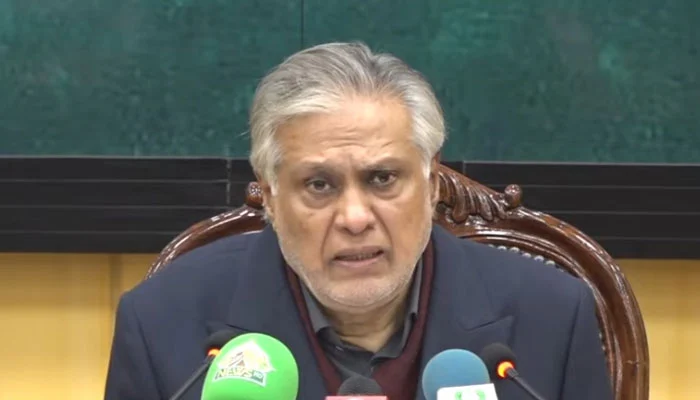
ISLAMABAD: Deputy Prime Minister/Foreign Minister Ishaq Dar has said New Delhi has undermined the international legal system and exposed the region to conflict by illegally holding the Indus Waters Treaty (IWT) in abeyance.
He was speaking at the concluding session of an international seminar on “Indus Waters Treaty: an instrument of peace and regional stability” organised by the Institute of Regional Studies (IRS) in collaboration with the Ministry of Information and Broadcasting here on Tuesday.
Dar pointed out that the sanctity of treaties was one of the foundations on which peaceful relations between nations were built. He urged the international community not to allow the weaponisation of water. He called for viewing transboundary rivers as instruments of bringing countries closer to each other rather than becoming sources of discord. He added that it was in this spirit that Pakistan signed the IWT with India, despite the fact that it demanded significant concessions from Pakistan.
Islamabad, he said, believed that the treaty would provide long-term predictability on the use of one of the most significant shared regional resources. He expressed serious concerns over the Indian announcement of holding the treaty in abeyance as well as its refusal to cooperate with Pakistan on the shared resource as per the treaty.
Dar urged India to “live like good neighbours” and resolve all issues via dialogue and diplomacy, stating that “it takes two to tango”. He warned India against violating the IWT, saying the cost of sabotaging an international agreement on rivers could be very high. He said the consequences of violating international law and agreements were not limited to just two countries.
“Such actions set a dangerous precedent in international relations,” Dar said, adding that the violation of agreements spoils the reputation of states. He said long-term peace was possible only through mutual respect and state sovereignty. “If Pakistan is deprived of its water rights, it will have serious consequences,” Dar warned.
Recalling the past attempts to resolve issues with India through dialogue, he said, “We in all sincerity are ready to talk on all issues, but we call for composite dialogue, but it takes two to tango.” Dar lamented that India had become so “narrow-minded that even the sports were now subjected to this Hindutva philosophy”.
Earlier in the day, speaking during the inaugural session of the seminar, Tarar warned that Pakistan’s leadership was ready to give an effective response if any attempts were made to stop the country’s water, reaffirming that Islamabad would safeguard the sanctity of the IWT under all circumstances. Tarar said Pakistan remained committed to ensuring that the treaty remained intact. The minister said the 1960 Indus Waters Treaty held a unique place in international relations and remained one of the world’s most enduring water-sharing agreements.
“We are not merely discussing a treaty, but the lifeline of 240 million people,” Tarar said, adding that water was not just a natural resource for Pakistan but a matter of national survival. He said Pakistan had consistently maintained that its people had a legitimate and complete right over the waters of the Indus River, warning that any attempt to stop or divert Pakistan’s water would receive an effective response from the country’s leadership.
The minister said Pakistan always demonstrated its commitment to peaceful relations, constructive dialogue and sincere implementation of international agreements. He noted that IWT was established more than six decades ago through mutual consent between the two countries. He stressed that any changes to the treaty could only be made through mutual agreement, adding that the unilateral suspension of the treaty had embarrassed India at international forums.
Tarar said Indian disregard for IWT was weakening the sanctity of the international legal system, as well as global peace and order. He maintained that India’s failed attempt at illegally holding the treaty in abeyance led to international embarrassment for New Delhi. “The moral, social, and legal foundations of this attempt are weak,” he said. He urged the international community to take note of the illegal Indian attempts at altering the status of the treaty, especially in the face of a global climate crisis.
In his keynote address, Bilawal Bhutto Zardari, Chairperson Pakistan Peoples Party, said if peace could not be imagined with the Strait of Hormuz blocked, how the world could expect peace and stability in the region with the IWT held in abeyance. He said India had weaponised water by targeting Pakistan’s lifeline. He called for treating every Indian action in violation of the IWT as an act of war against Pakistan. He urged the international community to support Pakistan in challenging Indian illegal actions on the IWT to avoid escalation of conflict in the region and leading it to a strategic catastrophe. He called for an international convention against weaponisation of global commons, including water.
Dr Musadik Masood Malik, Federal Minister for Climate Change and Environmental Coordination, said Indian illegal actions on the IWT were compounding the climate crisis in Pakistan. “It is neither a crisis of climate nor a crisis of water but a crisis of justice,” he said. He added that by violating one of the strongest treaties of the world, India had shaken the foundations of the international legal system. He further stated that Indian actions were redefining the rights of lower riparian countries across the world, which should alert the international community to its global consequences. Hina Rabbani Khar, former minister of state for foreign affairs, observed that the IWT laid out the mechanism for any alteration to it. She added that India had managed to get away with its illegal action regarding an internationally binding treaty because of the uncertain state of the global order.
Pakistan’s Commissioner for Indus Waters Syed Mehr Ali Shah said Indian actions were against the dispute resolution mechanisms provided for in Article IX of the treaty itself. He regretted the suspension of data flows from India under the treaty.
He said a letter was sent to India just a day earlier seeking data sharing under the agreement.
Dr. Roxolana Zigon, the head of the Scientific Centre for International & Strategic Studies at the University of World Civilisations in Moscow, shared that the IWT was widely celebrated for its durability internationally. She lauded the responsible approach of Pakistani decision-makers in the wake of Indian actions, especially when provocative statements were coming out from senior-ranking Indian decision-makers.
Ms. Laurie Watkins, author and global policy expert from the US, argued that New Delhi’s decision to withhold data and not respond to Pakistan’s written correspondences about highly inconsistent river flows violated principles of customary international law even if it had held the IWT in abeyance.
Prof Victor Gao, Vice President, Centre for China and Globalisation, Beijing, termed Indian suspension of the IWT a crime against humanity. He maintained that India was a midstream country because even if it was an upper riparian to Pakistan, it was a lower riparian to China. He added that Beijing could deter Indian attempts to coerce Pakistan through weaponisation of water.
Khurram Dastagir Khan, former federal minister for defence, listed all the illegal actions New Delhi took after holding the IWT in abeyance, including the closure of gates of Baglihar and Salal dams and fast-tracking of water projects on rivers covered by the IWT.
Lt Gen (retd) Amir Riaz, former president of the National Defence University, said the Indus River system provided water to the world’s largest irrigation network. He said the river system supported Pakistan’s agriculture, economy and energy needs. “The life, development, and prosperity of Pakistan are linked to this system,” he said, warning that attempts to seize the country’s share of water were a serious threat to its national security.
Ahmer Bilal Soofi, former caretaker federal minister for law and justice, and Jauhar Saleem, President IRS, also addressed the gathering.