The policy of disengagement was enforced rigidly. In February 2024, four months into the war in Gaza, the government told the Inter Faith Network it would withdraw funding unless it removed a newly elected board member over his links to the MCB. The network refused and was subsequently defunded, a move criticised by faith leaders as political vandalism at a time when interfaith work was urgently needed.
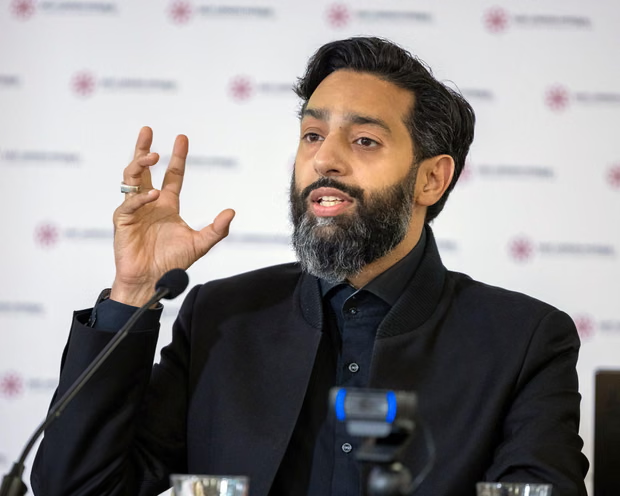
Although Labour engaged with the MCB in opposition, it maintained the policy of non-engagement in government, a move that prompted shock and anger. “We understand that they’re not going to engage with us out of pity, or even out of the national interest,” Akhter said. “They will eventually engage with us because they have no other choice.”
He said the council was shifting its “qibla”– the direction Muslims pray towards – away from seeking government approval and towards improving the lives of British Muslims and the wider public. He saidmosques should be reimagined as “more than just a place to pray”, acting as community hubs. Pilot schemes offering mental health first aid and CPR training in mosques have already been rolled out.
He also called for a change in how British Muslims thought about charity, with more focus on domestic priorities such as knife crime, housing and the economy, rather than overwhelmingly directing “zakat” – charitable contributions that Muslims must make – overseas.
“I take inspiration from black churches during the civil rights movement, from the anti-slavery movement in this country,” Akhter said. “Every one of these movements, when they started off, felt like they were fighting against impossible odds with next to nothing in terms of resources. But the one feature they all had in common was the people refused to give up on them.”
He said the rise of Islamophobic parties and politicians had made collective action more urgent. “In a world where everyone’s going right, we dare to go left sometimes, in a world where faith is no longer popular, we stick to ours,” he said.
The self-described history buff said British Muslims should take inspiration from the country’s resistance to Nazi Germany. “They did not flinch. They said if they write the history of this country for 1,000 years, let them say, this is our finest moment. This is our moment as British Muslims. It’s that same hatred, fascism, the ideology that some people are uniquely to blame for problems of society.”
He said the community had many allies in the UK. “The majority of this country is not on the side of the right wing. They don’t believe all this nonsense, but are upset and they want change.” He rejected claims that British Muslims did not belong, pointing to polling that showed they were more loyal to the UK than the general public.
He described himself as at ease with his British Muslim identity, recalling a recent pilgrimage to Mecca. “We had people from 190 countries there, but they kept referring to me as that Brit,” he said. “They could tell us a mile off.”
Amid crowds gathering to kiss the black stone of the Ka’bah, “everyone was pushing and shoving,” he said. “One of my friends asked if people could just form an orderly queue. Everyone started laughing.”