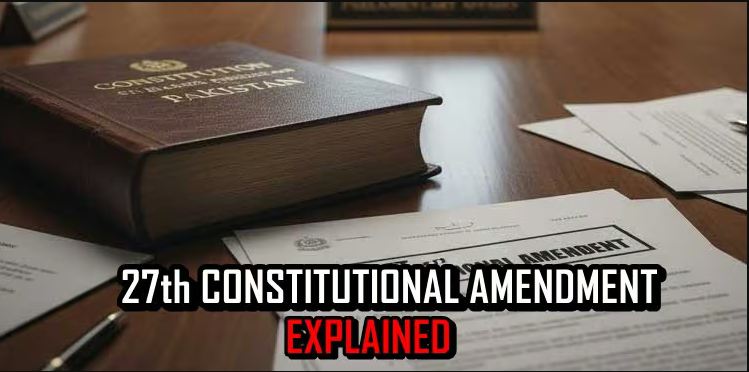
27th Constitutional Amendment: Explained
ISLAMABAD – Pakistan Peoples Party (PPP) Chairman Bilawal Bhutto Zardari has revealed that Prime Minister Shehbaz Sharif personally approached PPP for support on the controversial 27th Constitutional Amendment.
Prime Minister, leading a delegation from Pakistan Muslim League-N, met with him and President Asif Ali Zardari to secure backing for the amendment, which is set to shake up the country’s political and judicial landscape.
The proposed amendment covers wide range of sensitive issues, including the creation of constitutional courts, restoration of executive magistrates, transfer powers of judges, changes in provincial shares under the NFC, amendments to Article 243, the federal takeover of education and population welfare ministries, and a mechanism to resolve deadlocks in appointing the Chief Election Commissioner.
Key Features of Draft Amendment Explained
Changes to Provincial Revenue Share (Article 160 & Clause 3A)
The draft aims to remove certain protections that guarantee provinces a fixed share of federal funds. This could reduce provincial autonomy, as provinces would have less control over how federal money is spent locally.
Judicial Reforms and New Constitutional Court (Article 191A & New Article)
The amendment proposes scrapping Article 191A and creating a new Constitutional Court (or Supreme Constitutional Court). This court would have the final say on constitutional matters. It also suggests changes in how High Court judges can be transferred.
Reversal of 18th Amendment Transfers (Schedules II & III)
Powers that were given to provinces under the 18th Amendment, such as overseeing education and population planning, would go back to the federal government.
Control Over Armed Forces (Article 243)
The federal government would gain more authority over the military’s command structure, giving the center greater control.
Appointment of Chief Election Commissioner (Article 213)
The process to appoint the Chief Election Commissioner would be revised to avoid delays and deadlocks, ensuring smoother election administration.
PPP’s Role
PPP has yet to finalize its position. Bilawal Bhutto Zardari confirmed that the party’s Central Executive Committee (CEC) will meet on November 6, after President Zardari returns from Doha, to decide whether to support the amendment. Since constitutional changes require a two-thirds majority in both houses, the PPP’s stance will be crucial.
This proposed amendment marks one of the most significant attempts to reshape Pakistan’s governance and federal structure in recent years.
Bilawal Bhutto announced that PPP’s Central Executive Committee will convene on November 6, immediately after President Zardari returns from Doha, to deliberate on this high-stakes political move.