
Trump takes credit as ceasefire in Iran-Israel war takes hold
WASHINGTON/JERUSALEM/TEHRAN – A fragile ceasefire in the Iran-Israel war appeared to be holding Tuesday, after 12 days of strikes that saw Israel and the United States pummel the Islamic republic’s nuclear sites.
US President Donald Trump, who had first declared the ceasefire, on Tuesday told Israel “do not drop those bombs” on Iran.
In Israel, no warning sirens sounded after 0745 GMT, while in Iran, the military reported the last strikes at around 0530 GMT. Israel said it had agreed to Trump’s ceasefire plan, adding that it had achieved all its objectives.
Iran stopped short of officially accepting the proposal, but its top security body said the Islamic republic’s forces had “compelled” Israel to “unilaterally” cease fire. Its foreign minister, Abbas Araghchi, had earlier said that if Israel stopped “its illegal aggression,” Tehran would have “no intention” to continue fighting.
US president Donald Trump said both Israel and Iran wanted to “stop the war equally” and that it was his “great honor” to destroy the latter’s nuclear capabilities.
Writing on his Truth Social network, he said: “Both Israel and Iran wanted to stop the War, equally! It was my great honor to Destroy All Nuclear facilities & capability, and then, STOP THE WAR!”
Earlier Tuesday, US President Donald Trump that a ceasefire between Iran and Israel was holding, shortly after he lashed out at both countries and cursed as he accused them of violating the truce.
In a fast-moving series of declarations, the 79-year-old Republican, who was on his way to attend a NATO summit in The Hague, posted on his Truth Social app that “the Ceasefire is in effect!”
“ISRAEL is not going to attack Iran. All planes will turn around and head home, while doing a friendly ‘Plane Wave’ to Iran. Nobody will be hurt,” Trump wrote.
Minutes earlier, he had castigated Iran and also close US ally Israel for violating a ceasefire he had originally announced late Monday.
Iran violated the ceasefire, “but Israel violated it too,” Trump told reporters on the White House’s South Lawn as he departed for the NATO summit.
“So I’m not happy with them. I’m not happy with Iran either. But I’m really unhappy if Israel is going out this morning.”
“I’ve got to get Israel to calm down,” he said. “Israel, as soon as we made the deal, they came out and dropped a load of bombs the likes of which I’ve never seen before.”
Trump’s unusually public display of anger at Israel saw the US leader apparently trying to cajole his ally to call off warplanes in real time.
Earlier the same morning, he had posted on Truth Social: “ISRAEL. DO NOT DROP THOSE BOMBS” — without it being clear which bombs he was referring to.
“IF YOU DO IT IS A MAJOR VIOLATION. BRING YOUR PILOTS HOME, NOW!”
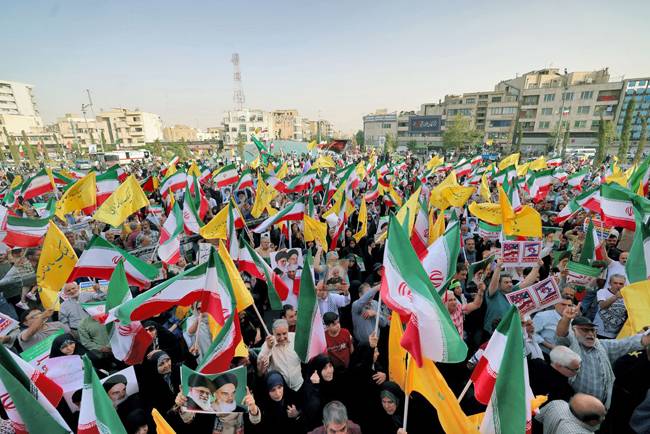
Iranian media outlets are broadcasting footage of a large crowd gathering in central Tehran, which they report is showing support and appreciation for the country’s armed forces. The gathering in Revolution Square was reported by state and state-affiliated news agencies IRNA, Fars and Mehr.
According to reports, demonstrators are vowing to stand by the armed forces until the end, praising their “crushing response to the aggressions” of Israel and the United States.
Video footage broadcast by Iranian media outlets showed people chanting in support of Iran while carrying Iranian flags and posters of Supreme Leader Ayatollah Ali Khamenei.
It’s unclear whether the Iranian regime organized the rally.
Iranian president Masoud Pezeshkian said Tehran was ready to resolve issues with the US based on international frameworks, during a phone call with Saudi crown prince Mohammed bin Salman, Iran’s official news agency IRNA reported on Tuesday.
Pezeshkian said earlier that Tehran would not violate the ceasefire deal unless Israel does, according to Iran’s state-run Nournews. US president earlier announced that the ceasefire deal had been reached between Israel and Iran.
Iranian airspace partially reopened, following the country’s ceasefire with Israel after 12 days of hostilities, according to aviation monitoring company FlightRadar24.
“Iranian airspace is now open to international arrivals and departures to/from Tehran with prior permission,” FlightRadar24 said on X. Iraqi airspace has also reopened, it added.
Iran “does not seek nuclear weapons in any way” but is “only seeking its legitimate rights,” its President Masoud Pezeshkian said on Tuesday, according to the state-affiliated Fars News Agency. “Iran is not Gaza or Lebanon that cannot respond to the military attacks of the Zionist regime,” Pezeshkian said during a phone call with United Arab Emirates President Sheikh Mohammed bin Zayed Al Nahyan.
“We expect you to explain to them in your interactions with America that the Islamic Republic of Iran is only seeking its legitimate rights and has no desire beyond that, it has not and does not seek nuclear weapons in any way,” Pezeshkian said as cited by Fars News Agency.
Iran “is only seeking to create a good future for its people, the region, and other countries by interacting with its neighbors and other countries,” Pezeshkian added.
600 killed in Iran since Israel’s initial attack
At least 606 people have been killed in Iran since Israel launched its attack on June 13, including 107 on Monday alone, according to figures shared by Iran’s health ministry during a crisis meeting in Tehran on Tuesday.
The ministry said 95% of the victims died at the scene of the attacks, with Monday marking the deadliest day of the conflict.
Israel struck a radar site north of Tehran on Tuesday but refrained from conducting further strikes after Prime Minister Benjamin Netanyahu spoke to US President Donald Trump, the Prime Minister’s Office (PMO) said in a statement.
The strike on Iran, which was launched hours after the ceasefire was due to go into effect, came after Israeli officials accused Tehran of violating the truce by firing several missiles at Israel.
The PMO said Trump “expressed his great appreciation for Israel” and that Netanyahu committed to refrain from additional strikes.
Israel bombed a target near Tehran on Tuesday despite a furious rebuke from U.S. President Donald Trump for launching airstrikes hours after agreeing to a ceasefire deal with Iran.
Trump scolded both Iran and Israel for early violations of the truce that he had announced at around 0500 GMT, but directed particularly stinging criticism at Washington’s close ally over the scale of its strikes, telling it to “calm down now”.
He said Israel called off further attacks at his command to preserve the deal to end a 12-day air war with Iran, the biggest ever military confrontation between the Middle East arch-foes that had raised fears of global repercussions.
Following those remarks, however, two witnesses reached by telephone in the Iranian capital said they heard two loud blasts.
Prime Minister Benjamin Netanyahu’s office acknowledged that Israel had bombed a radar site near Tehran in what it said was retaliation for Iranian missiles fired three-and-a-half hours after the ceasefire had been due to begin.
It said Israel had decided to refrain from further attacks following a call between Netanyahu and Trump, but did not explicitly say whether the strike on the radar site took place before or after they spoke.
Meanwhile,
Four people were killed and at least 22 others injured Tuesday morning when Iran fired six missile barrages in quick succession at Israel in the final hours before the intended start of a 7 a.m. ceasefire (Israel time) announced by US President Donald Trump.
Both Israel and Iran subsequently said they had accepted the truce. However, shortly before 10:30 a.m., missiles were once again launched at Israel, leading Jerusalem to promise a forceful military response.
Missiles repeatedly targeted the country’s center, north and south, starting shortly after 5 a.m., setting off sirens and sending millions of Israelis to bomb shelters.
Two missiles were fired at Beersheba in a salvo at 5:40 a.m., with one being intercepted and another striking the sixth floor of an apartment complex in the southern city, causing extensive destruction, including collapsing part of the building.
The building was relatively new, and homes had their own reinforced rooms. However, the missile directly hit two safe rooms, killing those inside them, according to a preliminary probe by Home Front Command. One of the bomb safe rooms was destroyed by the impact, the probe found.
The reinforced rooms are designed to sustain the shockwave of ballistic missiles as well as shrapnel — though not a direct strike from a large explosive warhead. Home Front Command says shelters are still the safest place to be during ballistic missile attacks.
The Israeli Air Force was investigating why the missile was not intercepted by air defenses.


