Kashmir Webinars and beyond Dr. Syed Nazir Gilani

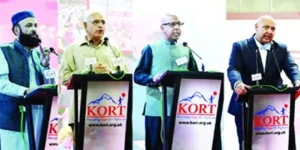
On the 4th and 5th of August, we saw an impressive surge in activities denouncing India’s
actions in Jammu and Kashmir since the ill-fated date of 5 August 2019. Across Pakistan and
global capitals, a unified voice resonated, echoing the term “IIOJK” (Indian Illegally
Occupied Jammu and Kashmir), while expressing solidarity with the people of the region
now known as IIOJK. However, it is time for us to candidly confront our past shortcomings
and re-set the compass.
In our historical pursuit of justice for the people of Kashmir, we have unwittingly engaged in
a series of meandering and misguided efforts. Regrettably, none of these endeavors have been
able to influence substantial action in alignment with the UN’s template on Kashmir. We have
fallen into the habit of repetitively referencing the implementation of UN Security Council
Resolutions, while overlooking the broader UN template that these resolutions have
collectively formed. This template lays out the foundation and fundamental principles for the
proposed plebiscite in Kashmir. Sadly, this vital work came to an abrupt halt following the
resignation of the UN-appointed Plebiscite Administrator in September 1953, who had
initially intended to hold a plebiscite by November 1, 1950.
An assembly of the world’s finest statesmen, representing nations including Australia,
Argentina, Belgium, Britain, Canada, China, Colombia, Cuba, France, the Netherlands,
Philippines, Russia, Syria, Ukraine, and the US, actively contributed to shaping the UN
template on Kashmir. Renowned military strategists like General Ismay, General Schemes,
Admiral Chester Nimitz of the US, and General McNaughton of Canada lent their expertise,
envisioning a plebiscite with credible security measures under impartial supervision.
It was unfortunate that the trajectory of the Kashmir case stagnated after Admiral Nimitz’s
resignation, without an earnest effort to replace him with an alternative figure, such as the
President of the International Committee of the Red Cross, a Swiss national. This oversight
became a point of contention, as appointing two US nationals to oversee demilitarization and
plebiscite procedures failed to gain universal approval.
To thaw the frozen state of the Kashmir case, we must procure the necessary tools to ignite a
transformative process. Indian journalist Aasha Khosa’s piece in The Voice on July 20, 2023,
in a polite rebuke recalled the days of the Hurriyat Conference, underscoring the passage of
time and the stagnation of once-vibrant initiatives like the Kashmir Awareness Bureau and
Kashmir Centers worldwide.
The art of condemnation also has its jurisprudence in the UN template. During the 611th
meeting of the UN Security Council on December 23, 1952, the Netherlands aptly noted that
violating an established agreement reached on Kashmir would constitute a grave offense
against the opposing party, the UN, and the right of the people of Jammu and Kashmir to
self-determination. However, the phase of condemnation has now concluded, leaving us
devoid of concrete actions post-August 4th and 5th.
While some entities in Azad Kashmir wield political and financial influence concerning
Kashmir, they remain reluctant to rally moral courage and demand a recalibration of their
approach to the UN template. It is imperative to scrutinize our obligations and implore the
Government of Pakistan, both as a UN member nation and a stakeholder in the Kashmir
dispute, to take action.
Pakistan’s “Complaint Against India” made in Document II, presented to the UN Security
Council on January 15, 1948, warned that the state’s accession to the Indian Union would
equate to signing its death warrant. Nevertheless, Pakistan’s inaction from 1965 to 1996, a
span of 31 years, cast a shadow on its commitment to the Kashmir issue. Rumours of a deal
on Kashmir and General Bajwa’s purported decision to distance from the matter for another
20 years further entrenched this state of non-action, amounting to 51 years of stagnation.
The Government of Azad Kashmir rightly laments its exclusion from the handling of the
Kashmir case, even though it enjoys privileges associated with the matter. Non-transparent
intra-agency arrangements have repeatedly fallen short on the Kashmir front, reflecting a lack
of comprehensive understanding of the case’s jurisprudence. These arrangements, revolving
around tenure, only lead to recurrent failures.
Pakistan’s call for India to reverse its August 5, 2019 action and initiate a dialogue is a
constructive proposition. Dialogue remains the hallmark of civilized nations for dispute
resolution. To facilitate an honourable exit for the Modi Government from the 2019 action,
Pakistan could support Kashmiri leadership’s non-hostile challenge in the Indian Supreme
Court.
This non-hostile strategy involves aligning arguments in the Supreme Court with the UN
template. Resolutions 91 (March 30, 1951) and 122 (January 24, 1957) of the UN Security
Council underscore the imperative for India (and vice versa for Pakistan) to respect the
State’s territorial integrity and adhere to the basic conditions and principles of the proposed
plebiscite. Encouraging Azad Kashmir, Gilgit-Baltistan, refugees in Pakistan, and the
Diaspora to rally behind this approach can invigorate support. Are we prepared to transcend
mere condemnation on August 4th and 5th and embark on this proactive path? Our
commitment must encompass the diverse communities within the UN’s Kashmir definition
and reflect the core political elements delineated in the UN template.
India’s statement at the 230 th meeting of the UN Security Council on 20 January 1948
eloquently conveyed its aspiration: that “We hope to be able to convince the Security Council
that once we have dealt with the Kashmir question, there will probably not be anything of
substance which will divide India and Pakistan to the extent of endangering international
peace and security”.
During the 533rd Security Council meeting on March 1, 1951, the Government of India
acknowledged, that “There exists a prevailing inclination in some circles to perceive this as a
mere conflict between India and Pakistan, dismissing the importance of the legitimate
government of Kashmir’s perspective. This notion is erroneous. As previously mentioned, the
jurisdiction of the Government of India over the affairs of Kashmir is confined to specific
domains; beyond these realms, its influence is advisory in nature and devoid of the power to
unilaterally enforce any determinations.”
This limited influence of the Government of India has been debated in the Report of The
State Autonomy Committee, published in July 2000. This report has been adopted by the two
houses of the Jammu and Kashmir Assembly. The fact that the Government of Jammu and
Kashmir retains a residual sovereignty on all matters except in the areas of Defence, External
Affairs and Communication, forms a challenge to India action of 5 August 2019 in the
Supreme Court of India. Government of Pakistan could take a non-hostile recourse by
invoking UN Security Council Resolutions 91 of 30 March 1951 and Resolution 122 of 24
January 1957.
The author is President of JKCHR – NGO in special consultative status with the UN.