Comment: The joint defence agreement
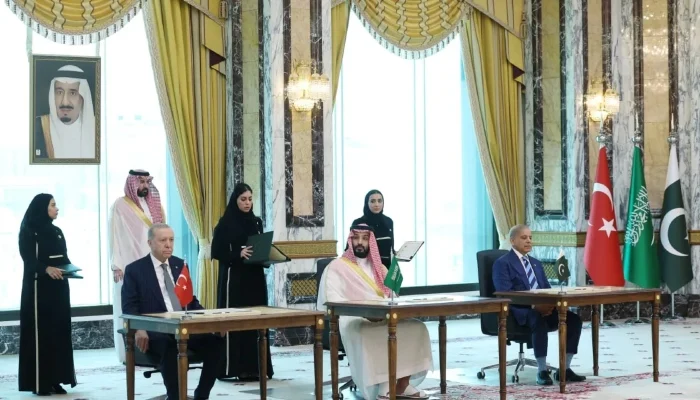
Three leaders sat down in Makkah on August 7 and signed something that will outlast the photo-op. MBS (Muhammad Bin Salman). Erdogan. Shehbaz Sharif. Saudi Arabia, Turkiye, Pakistan.
The core clause: an attack on any one of the three is now treated as an attack on all three. This builds directly on the bilateral pact Riyadh and Islamabad signed back in September 2025 — now there are three flags on the table, not two.
Here’s the number: $29 billion (my estimate). That’s the potential value of this agreement over five years, spread across six pillars — weapons and defence exports ($12 billion), Saudi-funded defence joint ventures inside Pakistan ($5 billion), Turkish technology and joint production ($4 billion), naval and air-defence cooperation ($3 billion), MRO and training ($3 billion), logistics contracts ($2 billion).
Fact: Saudi Arabia’s Public Investment Fund (PIF) alone manages $925 billion, with a board-approved target of $2 trillion by 2030. Against that scale, $29 billion over five years is not a stretch. It’s almost modest. The Gulf spends well over $130 billion a year on defence. This agreement, at full potential, captures a sliver of that — roughly $6 billion a year, if everything on the chart actually materialises.
Here’s what each side actually brings. Saudi Arabia brings capital — real capital, the kind that can write a check without blinking. Turkiye brings technology — drones, the KAAN fighter programme, an export machine that’s grown faster than almost anyone expected. Pakistan brings scale and combat experience — the JF-17, a production line already running, an army that has actually fought.
Put those three together and you get something none of the three could build alone. For the record, Nato’s Article 5 took decades of joint commands, integrated training, and standing budgets to mean something beyond a sentence. Makkah, so far, has the sentence. No secretariat has been announced. No joint command structure. No disclosed financing mechanism for the $29 billion figure itself — where the money comes from, who administers it, what happens when Riyadh’s fiscal year doesn’t match Islamabad’s needs.
None of that is a criticism. It’s a sequencing problem. Declarations always come first.There is already a template for how the small print gets written. Reuters has reported Pakistan and Saudi Arabia negotiating roughly $4 billion in JF-17-linked financing — part loan conversion, part fresh procurement. Pakistan has closed arms deals with Libya worth over $4 billion and is negotiating with Sudan, reportedly with Saudi involvement in the background. These are the early transactions. Small compared to $29 billion. But real.
The Gulf learned something expensive in June: weapons alone don’t buy security. Now it’s buying something else — depth, redundancy, a layer that isn’t Washington.Look closer: Pakistan is not standing at the margins of the emerging regional security order — Pakistan is moving towards the centre.
The day before yesterday these were three friendly states cooperating on defence. Yesterday they declared that an attack on one is an attack on all. That is the birth certificate of an alliance.
The writer is an Islamabad-based columnist.