Pakistan expresses deep concern over flare-up: Iran expands attacks on Gulf states after US strikes
WASHINGTON/DUBAI/ISLAMABAD: US and Iranian forces have exchanged heavy missile and drone assaults, with Tehran targeting US facilities in states across the Gulf on Sunday and saying it had again closed the vital Strait of Hormuz.
The strikes were the latest in a cycle of attacks and counter-attacks as Iran seeks to assert control over shipping through the strait. However, the barrage marked an escalation in pace and range.
The strikes extended to Qatar, a mediator in ceasefire talks that had not come under attack since April, while the United Arab Emirates, which had not been targeted since early May, said its air defenses had engaged missiles and drones from Iran.
On Sunday afternoon, Iranian media said there had been missile attacks and explosions around the port of Bandar Abbas, home to military facilities on the strait, and nearby Qeshm Island, as the US reportedly launched another round of attacks and Iran targeted Kuwait.
The renewed violence casts further doubt on the future of an interim US-Iranian agreement signed last month that aimed to reopen the strait and end the war after a further 60 days of negotiations.
In the past week, U.S. President Donald Trump has said he considers the ceasefire over, while leaving the door open to more talks.
The war that the US and Israel launched against Iran on February 28 has destabilised the Gulf, where Iran has struck countries hosting US bases. Iran’s effective blockade of the strait has driven energy prices higher, fuelling global inflation.
Higher prices, especially for gasoline, are politically sensitive for Trump ahead of November’s congressional elections.
Iran has sought to establish a permanent system for collecting fees in the strait, which carried one-fifth of the world’s oil and liquefied natural gas shipments before the war, and has warned vessels not to sail without its authorisation.
It said late on Saturday it had closed the waterway after firing a warning shot that struck a vessel travelling on an unauthorised route. On Sunday, it said it had disabled a second vessel.
India said one of its nationals was missing after an attack on the container ship GFS Galaxy off the coast of Oman. Oman said 23 crew members had been rescued. Qatar advised all vessels, including leisure boats, fishing boats and jet skis, to suspend activities.
Iran’s recently created Persian Gulf Strait Authority said on Sunday that passage through the strait was not currently possible due to “recent illegal movements of the United States military forces in the region”. Permits would be issued “as soon as stability and calm are restored,” it said.
The US, which revoked the licence authorising the sale of Iranian crude on Tuesday following earlier attacks on shipping, said its forces were positioned to safeguard freedom of navigation despite what it described as “aggression, harassment, threats, and arbitrary declarations” from Iran. “Iran does not control the strait. Traffic is flowing,” it said.
The US Navy-led Joint Maritime Information Centre reiterated guidance that, despite a severe security threat, an “expanded” southern route near Oman was available for two-way traffic.
On Saturday, US Central Command said US forces had hit 140 Iranian military targets, and that more than 300 had been struck over three nights this week “to degrade Iran’s ability to attack civilian mariners and commercial vessels freely transiting the strait.”
Iranian media reported explosions in Bandar Abbas, Sirik, Jask and on Qeshm, as well as in Khuzestan province, with one soldier reported killed in the southern city of Jask.
In response, Iran’s Revolutionary Guards said they had destroyed a command-and-control centre and drone hangars in US ally Jordan, targeted a US radar site and later rocket launcher systems in Kuwait, attacked US aircraft carrier support and refueling platforms in Oman and destroyed a jet maintenance centre and command facility in Qatar.
Qatar, which has previously said it would not act as a mediator so long as it was under attack, said three people, including a child, had been injured by falling shrapnel. It said Iran was “fully legally responsible” for the attack.
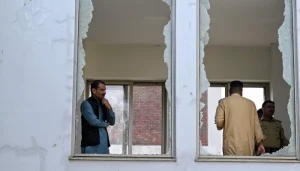
The UAE said it detected missile threats outside its borders, Bahrain said it intercepted several Iranian aerial attacks, Jordan reported missile strikes and Oman reported being targeted with drones. Kuwait’s army later reported damage from strikes, and said an attack on an oil drilling platform injured a worker.
Oman said it had summoned Iran’s ambassador to protest over drone attacks in two regions and the U.S. embassy in Oman told its nationals in Duqm and Musandam to shelter in place.
The latest round of hostilities came after talks in Oman on Saturday between Iran’s Foreign Minister Abbas Araghchi and Omani Foreign Minister Badr Albusaidi. Iran said the talks were aimed at coordinating arrangements in the Strait of Hormuz, and were set to continue with a Qatari presence.
Meanwhile, Iran’s top negotiator Mohammad Baqer Qalibaf posted on X on Sunday: “The era of one-sided deals is OVER. We told you: keep your word or pay the price. Reality is knocking.”
President Donald Trump said the United States hit Iran hard in response to its latest attacks on shipping in the Strait of Hormuz. “We hit them very hard last night,” Trump told CNN by telephone in an interview centering mainly on the death of Senator Lindsey Graham.
Trump said the United States and Iran had been close to “a deal” on Saturday. “They were giving up everything, and then all of a sudden two hours after that they hit a ship with a drone. These people, there is something wrong with them,” he said.
Kuwait’s defence ministry said that three border posts and an offshore oil platform were attacked during a fresh exchange of strikes between the United States and Iran.
Qatar condemned Iranian attacks against its territory and its neighbours, after the Islamic republic launched salvos against Arab countries. “Qatar condemns in the strongest possible terms the renewed attacks carried out by the Islamic Republic of Iran,” the foreign ministry said in a statement, also referring to the targeting of Jordan, the United Arab Emirates, Bahrain, Oman and Kuwait and calling the barrages a “dangerous escalation”.
An adviser to Iran’s supreme leader said that the Strait of Hormuz was more important than “dozens of atomic bombs”, vowing to protect the vital waterway.
“This strategic passage is more important than dozens of atomic bombs, and the Islamic Republic of Iran will protect it,” Mohsen Rezaee was quoted by the ISNA news agency as saying.
UN Secretary-General Antonio Guterres urged the United States and Iran to halt their new outbreak of fighting and resume talks to end it.
Guterres specifically mentioned US attacks on Iran and the latter’s strikes on ships in the Strait of Hormuz and US allies in the Gulf region. “These attacks must stop,” Guterres spokesman Stephane Dujarric said in a statement.
Iranian state media reported that an employee of a telecommunications company was killed in attacks in the southern province of Hormozgan on the Gulf.
Jordan’s army said that three Iranian missiles fell on the kingdom’s territory. “The damage is limited to minor material losses,” said a military source quoted in an army statement.
The Iranian Revolutionary Guards announced they had hit a second vessel in the Strait of Hormuz on Sunday, state media reported. “A second vessel accused of violating regulations in the Strait of Hormuz has been struck,” the Guards said in a statement carried by state television IRIB, adding they had also attacked a US base in Qatar.
Meanwhile, Deputy Prime Minister/ Foreign Minister (DPM/ FM) Ishaq Dar Sunday stressed upon the parties to follow the path of de-escalation and show restraint, as agreed in the Islamabad MoU.
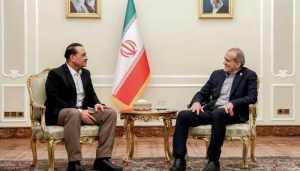
The DPM/ FM held a telephone conversation with Iran’s Foreign Minister Abbas Araghchi, the Foreign Office spokesperson said in a press release. Both leaders exchanged views on the evolving regional situation.
Dar further underscored that dialogue and diplomacy remain the only viable path to resolving disputes and achieving lasting peace and stability in the region.
He reiterated Pakistan’s readiness to continue playing a constructive role in promoting and maintaining regional peace and stability,” it was added.
The two leaders agreed to remain in close contact.
Meanwhile, the DPM/FM and Saudi Arabia’s Ambassador to Pakistan Nawaf bin Saeed Ahmad Al-Malkiy also exchanged views on the latest regional developments and underscored the need to strengthen collective efforts aimed at promoting dialogue and diplomacy.
Al-Malkiy called on Dar, the spokesperson said in another press release. They reaffirmed their commitment to further deepening Pakistan-Saudi Arabia relations across all areas of mutual interest for the benefit of both nations, it was further added.
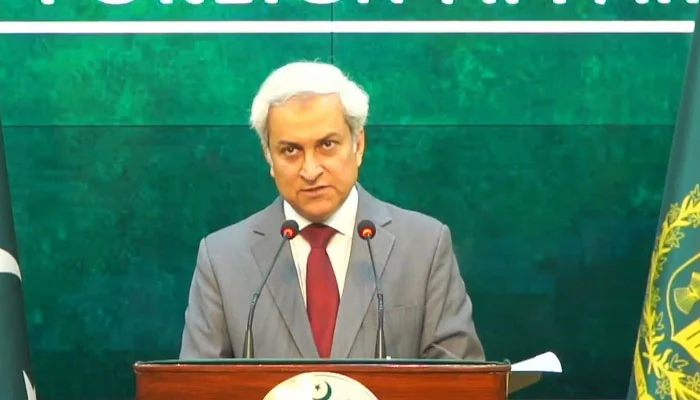
Also Pakistan is following with deep concern the recent incidents that are further escalating the regional tensions, the FO spokesperson said.
In a statement, he said, “Pakistan reiterates its strong support for the sovereignty and territorial integrity of all brotherly countries in the region, and urges all sides to exercise restraint, take immediate steps towards de-escalation, and uphold respective commitments under the Islamabad MoU.
“On its part, Pakistan remains committed to providing all support towards achieving lasting peace and stability in the region through dialogue and diplomacy,” he added.
Meanwhile, the survivors of Iranian attack in Kuwait that killed 6 US troops say generals ignored warnings. The drone strike on Port Shuaiba in Kuwait occurred on the second day of the war. Those who were there say they fear no one will be held accountable, Washington Post reported.