Iran says time for US to decide ‘whether it can earn our trust’ after talks
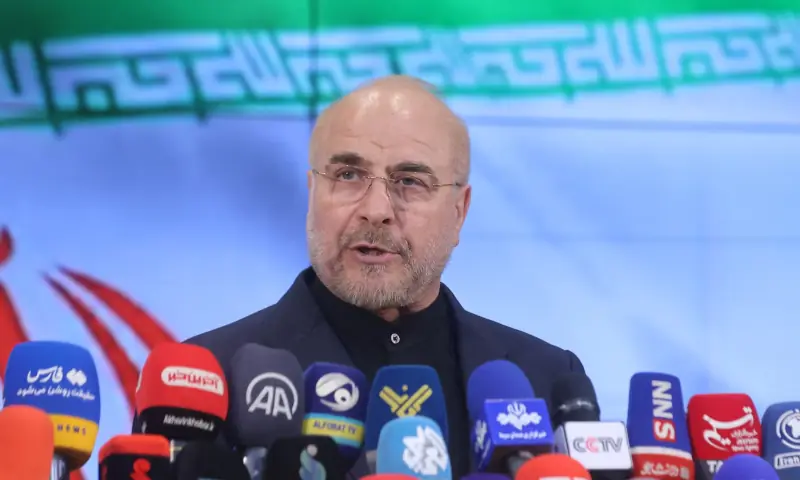
After their face-to-face talks yielded no agreement, Iran’s Parliament Speaker Mohammad Bagher Ghalibaf on Sunday said it was now time for the United States to decide whether it can “earn” Tehran’s trust.
In a post on X, written in Persian, Ghalibaf said: “America has understood our logic and principles, and now it’s time for it to decide whether it can earn our trust or not?”
Ghalibaf, who led the Iranian delegation, recalled that before the negotiations, he “emphasised that we have the necessary good faith and will, but due to the experiences of the two previous wars, we have no trust in the opposing side”.
“My colleagues on the Iranian delegation Minaab168 raised forward-looking initiatives, but the opposing side ultimately failed to gain the trust of the Iranian delegation in this round of negotiations,” he added.
The Iranian parliament speaker went on to state: “We certainly consider diplomacy of authority to be another method, alongside military struggle, for achieving the rights of the Iranian people, and we will not stop for a moment from trying to consolidate the achievements of the 40 days of Iranian national defence.”
Ghalibaf also thanked the efforts of “our friendly and brotherly country” Pakistan, for facilitating the process of the negotiations, sending his regards to Pakistanis.
Remarking that Iran was a “body with 90 million souls”, Ghalibaf expressed his gratitude to the people of Iran who, “following the advice of the Supreme Leader and by taking to the streets, supported their children and sent us on our way with their blessings”.
“To my colleagues in these intense 21-hour negotiations, I say: well done, may God strengthen you. Long live and enduring be our dear Iran!”
Ghalibaf’s statement comes after a historic direct dialogue between Iran and the United States — known as the Islamabad Talks — ended without an agreement on Sunday.
Delegations from the two sides, with Ghalibaf leading the Iranian side and US Vice President JD Vance leading Washington’s effort, had met in Islamabad on Saturday for talks mediated by Pakistan.
The trilateral talks, which commenced on Saturday afternoon, saw the US and Iranian delegations engage in discussions over three sessions, with teams of experts from the two parties exchanging written texts after each session.
After discussions that went on for at least 21 hours, Vance held a press conference in the federal capital on Sunday morning, announcing that “unfortunately, we were unable to make any headway”.
Vance said both parties “had a number of substantive discussions”.
However, he added, “The bad news is that we have not reached an agreement, and I think that’s bad news for Iran much more than it’s bad news for the USA.”
The US vice president said Tehran’s leadership had “chosen not to accept our terms”.
Iran’s Foreign Ministry Spokesperson Esmaeil Baqaei, in remarks carried by Iranian state media, said the delegations reached “understanding” on several issues. However, he stated that “on 2-3 important issues, views were far apart, and ultimately, the talks did not lead to an agreement”.
Both sides appreciated the Pakistani leadership for its peace efforts and for hosting the dialogue. The two delegations departed Islamabad on Sunday morning.
Pakistan, Australia urge ceasefire continuation
In his statement on the talks’ conclusion, Deputy Prime Minister Ishaq Dar urged all parties to remain committed to the two-week ceasefire agreed on April 8.
“It is imperative that the parties continue to uphold their commitment to the ceasefire,” Dar said in a press conference in Islamabad shortly after Vance’s media briefing.
Dar expressed Pakistan’s readiness to continue to play its role to “facilitate engagement and dialogue” between the US and Iran.
He hoped that both sides would “continue with the positive spirit to achieve durable peace and prosperity for the entire region and beyond”.
Dar recalled that he, along with Chief of Defence Forces and Chief of the Army Staff Field Marshal Asim Munir, “helped mediate several rounds of intense and constructive negotiations between the two sides, that continued through the last 24 hours and ended this morning”.
Meanwhile, Australian Foreign Minister Penny Wong also urged a continuation of the Middle East ceasefire after US-Iran talks ended with no deal.
“The priority now must be to continue the ceasefire and return to negotiations,” Wong said in a statement, adding it was “disappointing that the Islamabad Talks between the United States and Iran have ended without agreement”.
“We continue to want to see a swift resolution to this conflict,” Wong was quoted as saying by Anadolu.
“Any escalation in the conflict would impose an even greater human cost and further impact the global economy.”