‘This likely isn’t over’: Journalists, analysts react to ‘stalemate’ in US-Iran talks
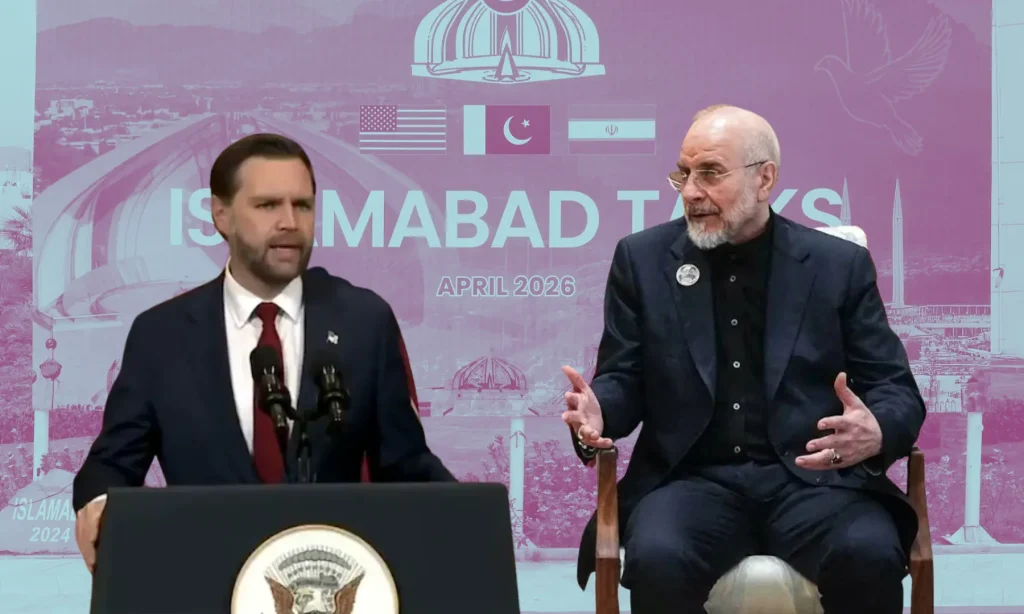
After a marathon 21 hours of high-level talks, delegations from the United States and Iran departed from Islamabad on Sunday morning without reaching an agreement.
The Islamabad Talks had the world, especially the Middle East, hoping that the 40-day US-Iran war would come to a permanent end. Both countries had agreed to a two-week ceasefire earlier this week, with Pakistan playing a key diplomatic role.
However, speaking to the media earlier today, US Vice President JD Vance said: “The bad news is that we have not reached an agreement, and I think that’s bad news for Iran much more than it’s bad news for the United States of America.”
“So we go back to the United States, having not come to an agreement. We’ve made very clear what our red lines are.” He also cited shortcomings in the talks, saying that Tehran had chosen not to accept American terms, including the building of nuclear weapons.
On the other hand, Iran’s semi-official Tasnim news agency said that “excessive” US demands had hindered an agreement.
“The success of this diplomatic process depends on the seriousness and good faith of the opposing side, refraining from excessive demands and unlawful requests, and the acceptance of Iran’s legitimate rights and interests,” wrote Iran’s Ministry of Foreign Affairs Spokesperson Esmaeil Baqaei in an X post.
He added that the delegations had reached an “understanding” on several issues; however, Baqaei stated that “on 2-3 important issues, views were far apart, and ultimately, the talks did not lead to an agreement”.
Here’s what analysts and journalists are saying about the latest developments:
‘Diplomatic option remains open’
Taking to X, Maleeha Lodhi, former ambassador to the US, UK and UN, said that it was “unrealistic to expect” a deal in just hours of talks when the “two sides’ positions were so far apart”.
“Neither side budged from these positions, which again was not surprising. But the diplomatic option remains open,” she added.
Beginning of the ‘diplomatic dance’
Commenting on the developments, Richard N. Haass, an American foreign policy expert, said negotiations always reflected ground realities. “So US efforts to impose peace terms on Iran were destined to fail.”
“That said, the 1st round of talks always has a throat-clearing quality, so chances of a breakthrough were negligible. The diplomatic dance is just beginning,” he added.
‘Not over’
In a post on X, Michael Kugelman, a Washington-based scholar of South Asian affairs, said the talks likely weren’t over. “More talks could come, but it’s unclear if they’ll be in Pakistan or elsewhere.”
“The US, for domestic political reasons, wants a deal that enables it to exit the war. That such a senior group flew all the way to Pak shows the US commitment,” he wrote.
“Despite Vance’s comments, this likely isn’t over.”
‘Only 24 hours’
Daniel DePetris, a foreign affairs columnist, said that a comprehensive agreement between Iran and the US was not possible in one day.
“Nearly 24 hours of talks is a lot, but it’s only 24 hours […] you weren’t going to solve nuclear, sanctions, Strait of Hormuz and terms to end the war in 21 hours,” he wrote on X.
“He (Vance) basically gave Iran an ultimatum: accept our terms because you’re not going to get a better agreement.
“The fact that Iran is still rejecting US demands despite 6 weeks of war shows just how confident it is right now,” DePetris added.
‘Difficult but not impossible’
Journalist and anchorperson Hamid Mir expressed hope that both the US and Iran would talk in the near future. “The whole world is waiting for a peace deal, which is difficult but not impossible,” he wrote on X.
Mir also highlighted that VP Vance praised Pakistan for hosting the 21-hour-long talks with Iran before departing for the US.
‘Diplomacy, not one-shot negotiation’
Journalist Raza Ahmad Rumi was also of the opinion that talks will resume, highlighting that Vance’s signal of no deal after last night’s talks reflected a “structural deadlock”.
“Washington is pushing for verifiable limits on enrichment and regional de-escalation, while Tehran is holding firm on sanctions relief and strategic autonomy. The gap was always going to be wide. The first round was less about agreement and more about testing red lines.
But this is diplomacy, not a one-shot negotiation,” he wrote on X.
Rumi said that “a collapse” would risk escalation in an already volatile region. “Markets, supply chains, and vulnerable economies would all take the hit. No serious actor can afford that outcome.”
Which is why, he continued, talks will resume.
“And in all this, Pakistan has quietly delivered a strategic win. By bringing Washington and Tehran into the same diplomatic space and opening a credible channel, it has shifted from the margins to the table at a critical geopolitical moment. Outcomes remain uncertain, but the fact of engagement itself is a durable achievement.
“In a fragmented world, creating the conditions for dialogue is no small feat,” the journalist added.
‘US arrogance’
On the other hand, former human rights minister Shireen Mazari said Pakistan did what it could, “but US arrogance never allowed for any rational compromise”.
“It sought to get from talks what it could not get through war,” she wrote in a post on X.
‘It can still happen’
“It was always going to be messy,” said journalist Khurram Husain.
“Ghalibaf and Vance have both hinted that resumption of talks is possible. Resumption of hostilities is harder to see right now, simply because there is no path for America to reopen the Straits militarily,” he added.
‘It doesn’t end here’
Journalist Iftikhar Firdous said there was a “stark contrast” between the statements issued by Iran and Vance, which reflected their two “fundamentally different diplomatic mindsets”.
“Iran frames the outcomes as part of a larger, broader historical and ideological struggle; we’ll endure, and therefore we will resist.
“While the US messaging is to leverage outcomes and national interest. We have the leverage, and therefore we can shape the outcome,” he explained in a post on X.
“On Pakistan’s side, it’s clear, as Foreign Minister Dar put it, it will continue to play the role to facilitate, it doesn’t end here,” Firdous added.
‘US intransigence’
Columnist Niaz Murtaza said that the failure of a breakthrough was disappointing news for everyone. “One had hoped there would be a breakthrough at least on extending the ceasefire and opening Hormuz.
“Perhaps that may still happen. But even the uncertainty is bad. US intransigence is the main reason,” he pointed out.
However, he added that the latest developments also bring lessons for Pakistan, which, according to Murtaza, “is now even more sucked into Middle East politics on top of its own regional and domestic issues”.
“And that is very risky,” he added.
‘Most serious effort’
Meanwhile, anchorperson Kamran Yousaf emphasised that even though the talks remain inconclusive, the dialogue was the “most serious effort yet to reach a deal”.
“Never before have the US and Iran spoken to each other directly at the highest level. The sticking point that eludes the deal remains the Strait of Hormuz,” he said.
Yousaf added that several ideas were floated during marathon talks, “but the stalemate persists”.
“In the end, Pakistan may not have achieved its ultimate goal, but its efforts to help broker a deal of the century will be in the history books,” the journalist said.
‘Space for dialogue’
Dr Tehmina Aslam Ranjha, columnist and research analyst, noted that even though the talks did not produce an agreement, Islamabad created space for dialogue in a moment charged with mistrust and brinkmanship.
“Bringing adversaries to the same table after decades is not routine diplomacy; it is strategic credibility in action,” she wrote on X.
‘Diplomacy is not dead’
In a similar vein, Journalist Anas Mallick said that while the talks had failed to produce a result, diplomacy was not dead.
“Negotiations have not entirely collapsed, and there might just be a ‘window’ to continue to collectively work towards a deal,” he posted on X.
‘Wait, please’
“Wait please,” said journalist Ansar Abbasi, highlighting that a decades-old conflict could not be resolved in a single round of negotiations.
“Pakistan helped facilitate a ceasefire, bringing much-needed relief to the world,” he said on X. “Pakistan also brought the US & Iran to the table for direct talks- a significant diplomatic achievement.”
Dialogue over deadlock
Journalist and author Gowhar Geelani said diplomacy was not a decoration, but a process. “Dialogue is better than a deadlock.”
“Even when neighbours have a dispute over a piece of land, it takes time to understand perspectives and requires several rounds of negotiations to arrive at a broad CMP. It is not instant coffee,” he added.
In another X post, he said America was “learning the hard way” that sovereign countries “cannot entertain its hegemony and accept its terms and conditions or red lines”.